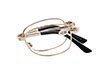
(1) Metal materials: Pure titanium, titanium alloys, and β-titanium have excellent corrosion resistance and are lightweight. Most mid-to-high-end metal eyewear frames use these three materials. 1. Pure titanium: Pure titanium refers to titanium metal materials with a purity of over 99%. Its characteristics are: high melting point, light weight, strong corrosion resistance, and a firm electroplating layer. Pure titanium is usually treated with heat treatment methods such as annealing, solution treatment, and aging. Annealing is to eliminate internal stress, improve plasticity and stability, and obtain better comprehensive performance. Advantages: It is not allergic to skin contact, does not rust, is lightweight, durable, and the electroplating layer is not prone to peeling, and will gradually darken with the increase of usage years. Disadvantages: The material is relatively soft, has no elasticity, is prone to deformation, and cannot make the frame finer. Only by making the lines thicker can the stability and strength be guaranteed.
3. β-titanium: β-titanium refers to titanium materials that are delayed cooled to form β particles at the zero-degree state. It is just a titanium material in another molecular state. The content of β-titanium is about 75%. For customers with high requirements for style and weight, they can choose eyewear frames made of β-titanium. Due to the higher processing technology of β-titanium, large-scale factories can produce it. Advantages: It has better fatigue resistance and environmental corrosion resistance, good plasticity, can be made into wire and thin plates, and is lighter. It can provide more shapes and styles for eyewear frames. Eyewear frames made of β-titanium will automatically return to their original shape when subjected to certain external pressure, so the frame legs or middle beams of some eyewear frames are made of β-titanium. β-titanium eyewear frames are generally slender, which compensates for the heavy weight of pure titanium eyewear frames. Disadvantages: If the myopia degree exceeds -4.50D, the edge of the lens is too thick and not aesthetically pleasing; the stability of the eyewear frame is poor, it is prone to deformation, the rivets are prone to loosen, and it brings many troubles to the wearer; the lens punching area is prone to cracking.
1. Acrylic cellulose: Acrylic cellulose material has been the main material for producing non-metal eyewear frames since the 1980s. Acrylic cellulose has two processing methods: injection molding and sheet forming. Sheet eyewear frames are representative. It is deeply loved by customers and has been the mainstream product of non-metal eyewear frame materials for a long time. Advantages: It does not fade, is not allergic, is easy to process, has a clear product shape and strong three-dimensionality, fashion, and other features. Disadvantages: The stability of the eyewear frame is extremely poor, prone to deformation, the anchor of the pin head hinge is not firm and is prone to fall off, the material is hard, and if the adjustment is not appropriate, the comfort is poor. Acidic materials cannot be used with PC materials for lenses (it will cause the lens to crack).
2. TR90: TR90 is also called plastic titanium and is a composite super elastic resin material used in eyewear manufacturing. The density of this material is 1.14-1.15, and it can float on the surface of salt water, suitable for teenagers who often exercise. Advantages: It is lightweight, slightly lighter than pure titanium; has excellent flexibility, is not prone to deformation, and has good elasticity. Disadvantages: The application is basically injection molding. This material is not adjustable after being made into a finished product. When using, the surface of the eyewear frame is prone to peeling or color fading. If no metal hinges are used, the eyewear frame is prone to damage and is not durable. Slide the 3TR90 to the right to view more information. The materials include tungsten-titanium (also known as plastic steel, tungsten-carbon, tungsten-carbon plastic steel, and aerospace PEI (ULTEM in Chinese: polyetherimide)). Advantages: Tungsten-titanium is an upgraded version of TR90, with better characteristics such as lighter weight, greater softness, and higher hardness and toughness. Disadvantages: The hinge head of the frame is prone to breakage, the hinge is easily broken, the material is "extremely brittle" and has poor shear strength, and the nose pad support and temple are prone to fall off. Tungsten-titanium eyewear frames are easily damaged, so they cannot be used to make children's eyewear frames.